about this letter
Colossians
Dear friend,
Grace and peace to you before you begin. You are about to walk slowly through a letter I sent to a little company of believers in a city I never saw with my own eyes — Colossae, in the valley of the Lycus. I want you to know, before you read a word of it, why it came to be written and what was pressing so hard upon my heart that I took up the pen even here, with a chain on my wrist.
I wrote it because they were in danger, though the danger wore a pleasant face. Voices had come among them — earnest voices, persuasive ones — teaching that Christ was not quite enough. That to be truly full, truly safe, truly wise, they must add something: rules about food and days, the worship of angels, visions, a harsh treatment of the body, a secret knowledge for the initiated. It all sounded like more. It was, in truth, less. For when you add anything to Christ, you have not enriched him — you have diminished him in your own eyes, as though the fullness of God dwelling in him bodily were somehow insufficient for you.
So I wrote to lift their eyes back to where they belonged. Not to me, not to their teachers, not to their own striving — but to him, in whom "are hidden all the treasures of wisdom and knowledge" (Colossians 2:3), in whom "the whole fullness of deity dwells bodily" (Colossians 2:9), by whom and for whom all things were made and in whom all things hold together (Colossians 1:16-17).
If you carry one thing through these mornings, carry this: you are complete in him. "You have been filled in him, who is the head of all rule and authority" (Colossians 2:10). You do not need the extra rung, the higher secret, the sterner discipline to be truly God's. The gospel that came to you at the first is the gospel still — it needs no additions, and it will bear no rivals. Read slowly. Let each morning set Christ a little more plainly before you, until you find your whole life "hidden with Christ in God" (Colossians 3:3), and are content there.
The story behind this letter
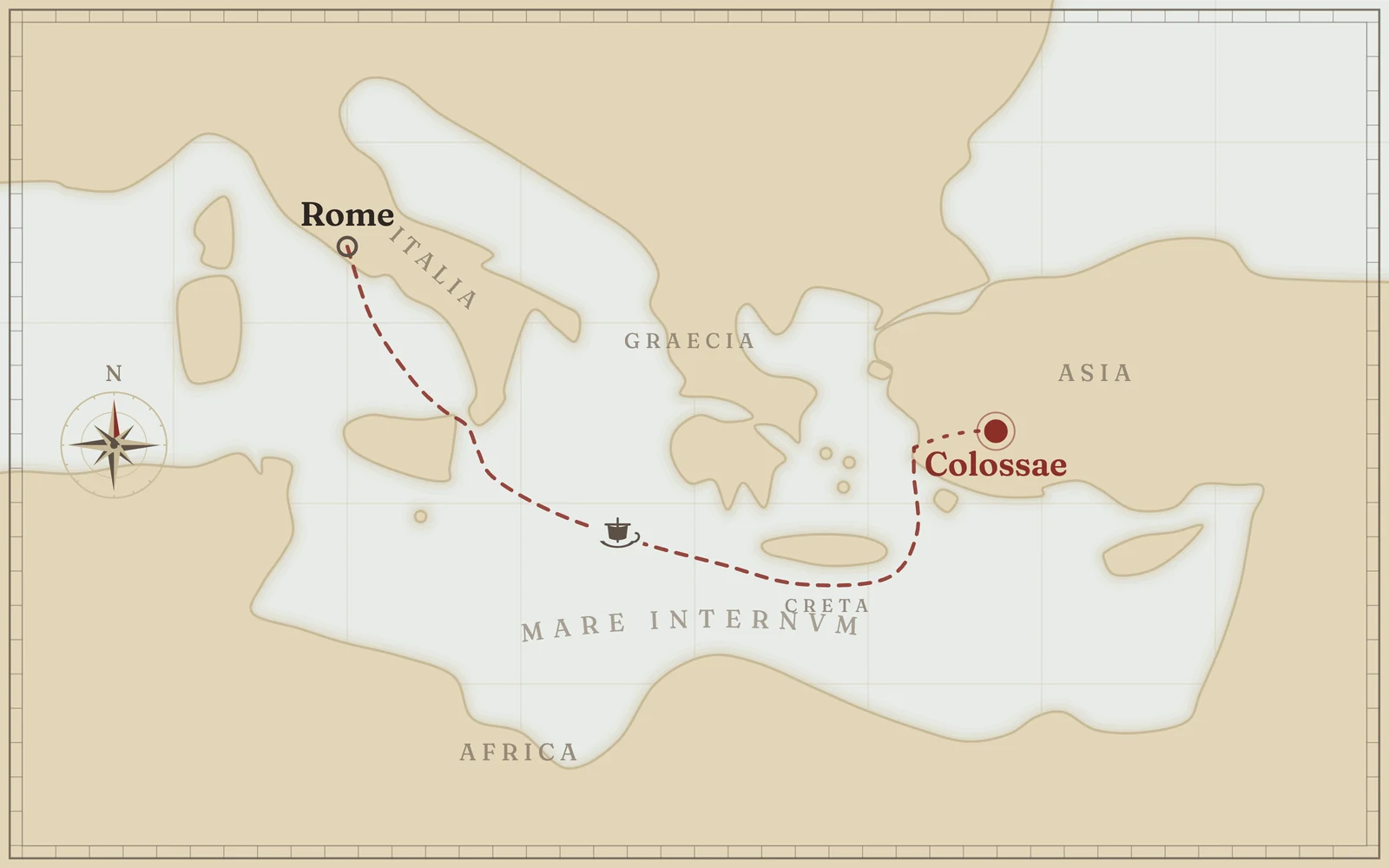
I wrote to the Colossians from prison, most likely during my confinement in Rome, kept under guard in a house where I could still receive all who came to me. Around the same season I sent letters to the Ephesians and to Philemon, and it was Tychicus who carried this one to them, along with Onesimus, a man of their own city (Colossians 4:7-9).
I had never met the Colossians face to face. The gospel had reached them not through me but through Epaphras, a faithful minister and one of their own, who had learned it from my work in Ephesus and carried it home to the Lycus valley (Colossians 1:7). It was Epaphras who came to me troubled for them, and his report gave rise to this letter. They were a young church, mostly Gentile, and a false teaching had crept in among them — a tangle of Jewish observance, angel-worship, ascetic rules, and a claimed higher wisdom, all of it whispering that Christ was a good beginning but not the whole.
Against this, the letter has one great theme sounded many ways: the supremacy and all-sufficiency of Christ. He is the image of the invisible God, the firstborn over all creation, the head of the body, the one in whom God was pleased to reconcile all things through the blood of his cross (Colossians 1:15-20).
The movement runs like this. It opens with thanksgiving and prayer for them, then rises to a great hymn of who Christ is and what his cross has done (chapter 1). From there it turns to warn them directly: do not be taken captive by hollow philosophy and empty rules, for in Christ you are already full and already free (chapter 2). Then, having settled the foundation, it shows what a life raised with Christ looks like — the old self put off, the new self put on, and this worked out in the ordinary places of home and labor and speech (chapters 3 and 4). It closes with greetings and the names of the friends laboring alongside me, ordinary saints in an ordinary town, held by an extraordinary Lord.
There's more here than a single reading can hold — the questions behind the questions, the threads that run letter to letter. That's what a study room with Paul is being made for.