about this letter
Ephesians
Grace and peace to you, dear reader, from God our Father and the Lord Jesus Christ.
You are about to walk slowly through a letter I wrote from a place much like the one I sit in now — bound, guarded, a prisoner for the sake of the Gentiles (Ephesians 3:1). And I tell you plainly at the start: this is not a letter I wrote to put out a fire. There was no scandal in Ephesus tearing the church apart, no false teacher I had to chase down with a hard word, as there was in Galatia. This letter came up out of me differently. It came up as worship.
I wanted the saints to see. To see what God had done before the foundation of the world, and what he has done now in Christ, and how the two of them — the eternal plan and the wandering sinner — are joined in one place at the cross. I wanted them to grasp how wide and long and high and deep the love of Christ is, though it surpasses knowledge (Ephesians 3:18-19). My knees were on the ground for these people more than my pen was on the page. Much of what you will read, I first prayed.
So do not read this quickly, and do not read it only with your head. You are walking through a house God is building, and you are one of its stones. The first half will tell you who you are in Christ — chosen, redeemed, forgiven, raised, seated, brought near, sealed with the Spirit. The second half will tell you how then to walk. But mark the order, and never let it slip: the walking comes second, and it comes because of the being. You do not climb your way up to God. In Christ you have already been brought near by his blood (Ephesians 2:13).
If you carry one thing with you through these mornings, carry this: it is all grace. "For by grace you have been saved through faith. And this is not your own doing; it is the gift of God, not a result of works, so that no one may boast" (Ephesians 2:8-9). You were dead, and God made you alive. Let that be the ground under your feet each day, and the rest of the letter will teach you how to stand there and how to walk from there.
The story behind this letter
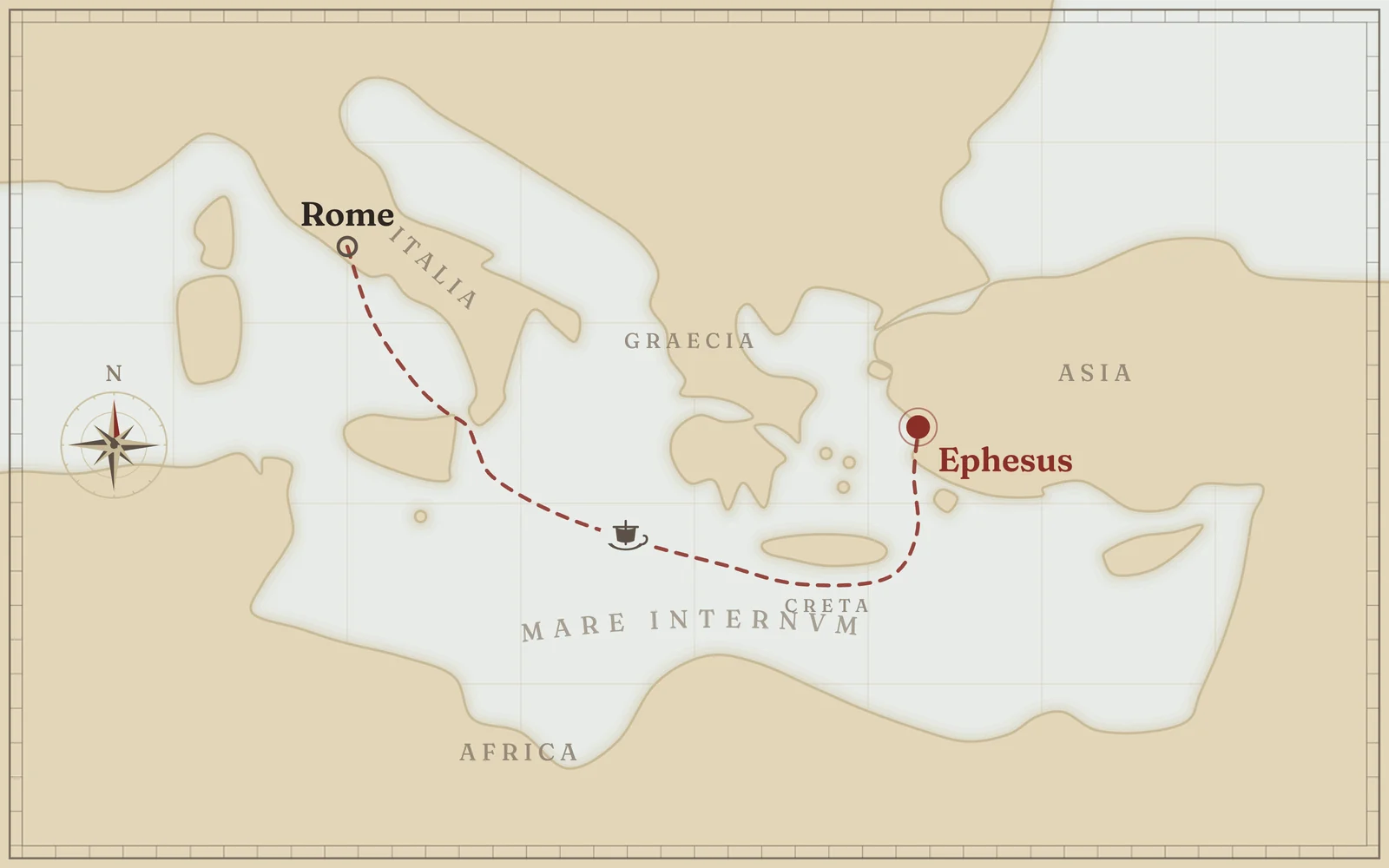
I wrote this while a prisoner of Rome, chained but able to receive those who come to me and to send letters out by trusted hands — the same season and much the same circumstance as the letters to Philippi, Colossae, and Philemon. Tychicus carried it (Ephesians 6:21), likely alongside the letter to Colossae, on the same journey.
The first readers were believers in and around Ephesus, a great port city of Asia, thick with commerce and crowded with the worship of Artemis and every kind of magic and idol. I had labored among them for some three years, teaching night and day with tears (Acts 20:31), so I knew them and loved them. Yet you will notice this letter names few of them by name and answers no local crisis directly — which is why many think it was written to be passed around and read in more than one gathering. It reads less like a reply to a problem and more like a summons to remember.
The great themes are these. First, God's eternal purpose: to unite all things in Christ (Ephesians 1:10). Second, salvation by grace alone, raising the spiritually dead to life. Third, the church — Jew and Gentile made one new man, one body, one temple, one household of God, the great mystery hidden for ages and now revealed. Fourth, the walk that follows: unity, holiness, marriage and family and work, and standing firm against the powers of darkness in the armor of God.
As for its shape, the letter turns on a hinge. The first three chapters look upward and backward — what God has done, doctrine soaked in prayer, closing with worship (Ephesians 3:20-21). The last three chapters look outward and forward — "walk in a manner worthy of the calling to which you have been called" (Ephesians 4:1) — and press that calling into your speech, your home, your labor, and finally into battle, where you take up the whole armor of God and stand (Ephesians 6:10-18). Sit in the gift before you take up the task. That is the road you are about to walk. Go slowly, and God be with you on it.
There's more here than a single reading can hold — the questions behind the questions, the threads that run letter to letter. That's what a study room with Paul is being made for.