about this letter
Philemon
Grace and peace to you, friend, as you sit down to walk slowly through this small letter of mine.
I want to tell you why I wrote it, for it is not like my other letters. It is not aimed at a whole church wrestling with the law, nor at a city torn by division. It is a letter about one man — a runaway slave named Onesimus — and about the friend I was asking to receive him back. It is short. You could read it in the time it takes to warm bread. But do not let its shortness fool you. Everything I have ever preached is folded up inside it.
Here is what pressed on my heart. Onesimus had wronged Philemon and fled from him, and somehow — by no accident, though it looked like one — he came to me here in my chains and I led him to Christ. He became a son to me, and dear, and useful (his very name means useful), and I would gladly have kept him near. But he was not mine to keep. He belonged, by the reckoning of this world, to another man — a brother of mine, a man I love, who had been changed by the same grace. So I sent Onesimus back. And I wrote ahead of him, to ask Philemon to receive him not as a slave now, but as a beloved brother.
I could have commanded. I chose to appeal. I will let you see why when you come to it.
The one thing I would have you carry through these mornings is this: watch what the gospel does to a debt. Watch what happens when a man who has been forgiven much is asked to forgive. See how Christ gets in between two people who were divided, and makes them one — not by pretending the wrong away, but by someone willing to say, charge it to me (Philemon 18). If you have understood that, you have understood the whole of it, and you will find you have understood something of the cross as well.
Read it slowly. It will reward you.
The story behind this letter
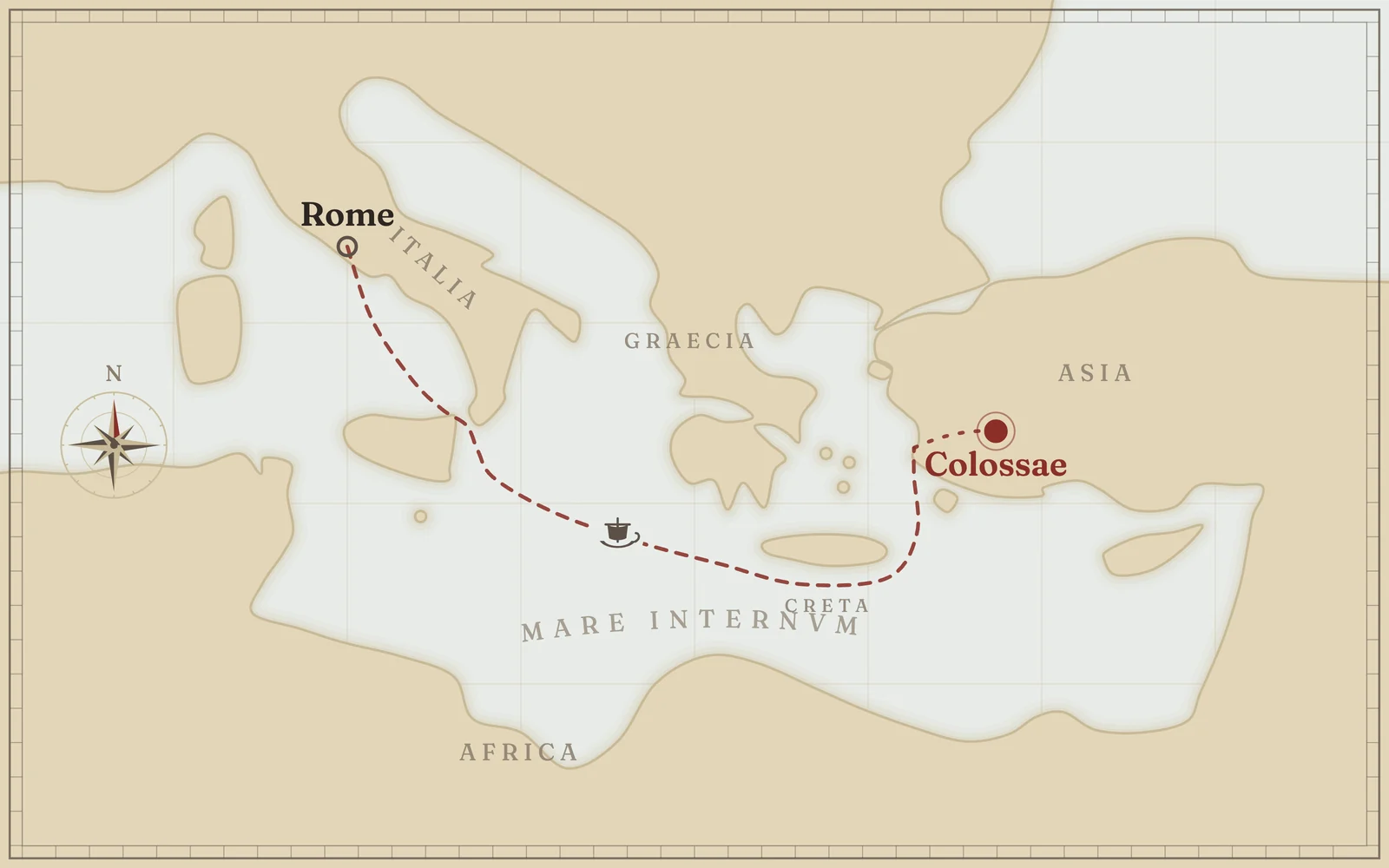
I wrote this letter from Rome, where I am held under guard in a rented house, allowed to receive those who come to me. I am in chains — you will see me call myself "a prisoner of Christ Jesus" from the very first line (Philemon 1) — and I wrote it around the same season as my letter to the Colossians, sending both by the same hand, for Onesimus himself carried them home to Colossae.
It was written to Philemon, a believer of some means in that city, in whose house a church gathered. With him I greet Apphia and Archippus and the whole church that met under his roof (Philemon 2) — for though the matter was private, I wanted it heard in the hearing of the fellowship. Philemon was a friend, a fellow worker, a man whose love and faith had refreshed many. He was also the master of Onesimus, the slave who had run from him, and likely robbed him in the fleeing.
The themes are few and deep: forgiveness, and the reconciling of two who were divided; the way faith remakes every earthly bond, so that master and slave become brothers; and the willingness of one man to take another's debt upon himself — which is the shape of the gospel in small. There is nothing abstract here. It is love put to the test of a real wrong and a real cost.
Watch its movement. I begin with thanksgiving for Philemon's love and faith, and warm his heart before I ask anything (Philemon 4–7). Then I make my appeal — not by command, though I could, but by love, for the sake of my child born in these chains (Philemon 8–16). I offer to pay whatever is owed (Philemon 17–19). And I close in confidence, certain he will do even more than I ask, and asking him to prepare me a room, for I hope to come to him (Philemon 21–22). It is a letter that begins in gratitude, turns on grace, and ends in hope.
The grace of our Lord Jesus Christ be with your spirit as you read.
There's more here than a single reading can hold — the questions behind the questions, the threads that run letter to letter. That's what a study room with Paul is being made for.