about this letter
Philippians
Grace and peace to you, dear reader, from God our Father and the Lord Jesus Christ.
You have set out to walk through this letter slowly, a little each morning, and I am glad of it. This one was written not from ease but from chains, and yet if you were to ask what word rings through it from first line to last, it is joy. Do not hurry past that. A man in prison, uncertain whether he will live or die, telling a church again and again to rejoice — there is something here worth sitting with in the quiet of your morning.
I wrote to the Philippians because I loved them, and because they had loved me. They were the first fruits of the gospel in Macedonia, and from the beginning they shared with me in my need when no one else did. When they heard I was imprisoned, they did not forget me; they sent Epaphroditus with a gift, and he nearly died for it. So this letter is, in part, a thank-you. But it is more. I wanted them to stand firm, to stop their small quarrels, to stop grasping and start giving themselves away as Christ did — who, being in the form of God, emptied himself and became obedient to death, even death on a cross (Philippians 2:6-8).
Here is the one thing I would have you carry as you read. I have learned to be content in any state, whether brought low or abounding, and the secret is not in me — "I can do all things through him who strengthens me" (Philippians 4:13). My joy did not depend on my circumstances, because it never rested there. It rested on Christ, who is my life, so that whether by life or by death he is honored in my body. That is the ground I want beneath your feet each morning: not that your days will be easy, but that Christ is enough, and that to live is Christ and to die is gain (Philippians 1:21).
Read slowly. Let it work on you. And know that a man in chains prayed for readers he would never meet, that your joy might be full.
The story behind this letter
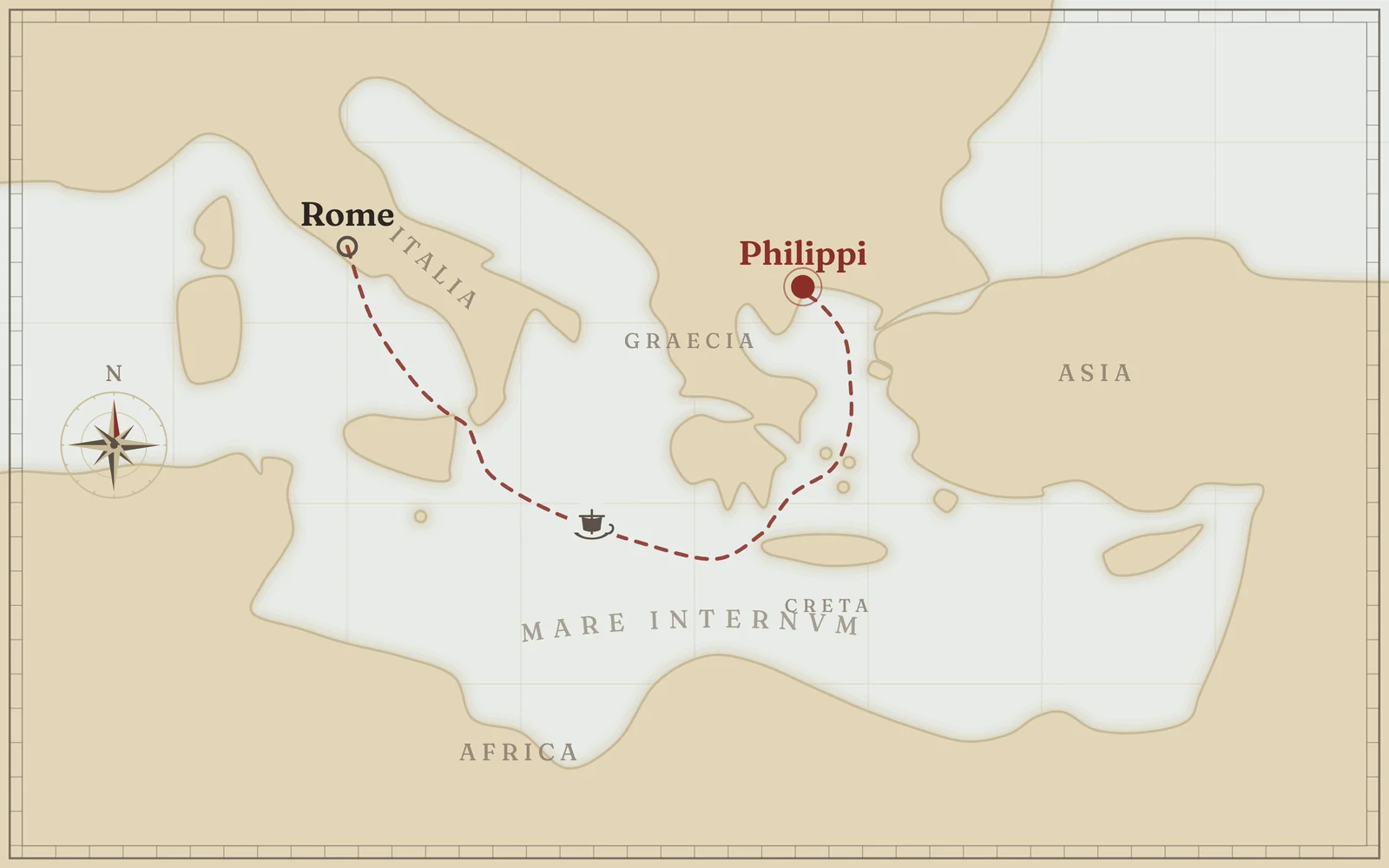
I wrote this letter from prison, most likely during my imprisonment in Rome, kept under guard in a rented house where I was still free to receive visitors and preach the gospel to all who came. I did not know how my trial would end — whether I would be released or executed — and you will hear that uncertainty woven through the letter, held always in peace rather than in fear.
The church at Philippi was one I had planted years before, in a Roman colony in Macedonia. It began with a handful of people — Lydia, a seller of purple cloth; a jailer and his household; a slave girl set free from a spirit of divination. From the start they were dear to me and generous beyond the others. Now they had heard of my imprisonment and sent Epaphroditus with a financial gift to support me. He fell gravely ill in his service and nearly died, and I was sending him home; this letter travels back with him.
The themes are few and they run deep. Joy in the midst of suffering — the word appears again and again, always from a place of chains. Unity and humility — for there were quarrels among them, and I set before them the mind of Christ, who humbled himself. The surpassing worth of knowing Christ — for I count everything I once prized as loss compared to him. And a warning against those who would add the law and the flesh to the finished work of the cross, for our confidence is in Christ alone, not in ourselves.
As for its shape: it opens with thanksgiving and prayer, and my reflection on how even my imprisonment has served to advance the gospel (chapter 1). It moves to the great call to humility, grounded in the self-emptying of Christ, and to shining as lights in a crooked world (chapter 2). It turns to warning and to my own testimony — counting all as loss, pressing on toward the goal (chapter 3). And it closes with peace, contentment, and gratitude: rejoice always, be anxious for nothing, and the peace of God will guard your hearts (chapter 4). Walk it in that order, morning by morning, and let each part rest on you before you move to the next.
There's more here than a single reading can hold — the questions behind the questions, the threads that run letter to letter. That's what a study room with Paul is being made for.