about this letter
Romans
To the one who is about to walk with me through this letter, grace to you and peace from God our Father and the Lord Jesus Christ.
I am glad you have chosen to go slowly. This letter cost me thought and prayer, and it will not give up its treasure to a hurried eye. Take it as you have said — a little each morning — and let it work on you the way rain works on dry ground, without your watching for the result. You will find I build one thing upon another, brick by brick, and I would rather you understood one paragraph and carried it into your day than swallowed ten and tasted none.
I wrote it to a people I had never yet seen. There were believers in Rome — Jews and Gentiles together, and not always easy together — and I longed to come to them and had been kept from it again and again. So I did what a man does when he cannot come in person: I sent the whole of what I preach, laid out in order, that they might know me and be strengthened before I arrived, and that I might be sent on my way by them toward Spain. I wanted no misunderstanding to stand between us. So I set down the gospel from the ground up.
And what pressed on my heart as I wrote was this — that the gospel is the power of God for salvation to everyone who believes, to the Jew first and also to the Greek (Romans 1:16). That no one is righteous, no, not one (Romans 3:10), and that God justifies the ungodly freely by his grace, through faith, on account of Christ crucified and raised. I had been a Pharisee blameless under the law, and it saved me not at all; mercy saved me on a road I was not seeking it. I wanted Rome to know that, and I want you to know it.
If you carry one thing through these mornings, carry this: that there is now no condemnation for those who are in Christ Jesus (Romans 8:1), and that nothing in all creation — not death, not life, not your own worst day — can separate you from the love of God in Christ Jesus our Lord (Romans 8:38–39). Everything else in the letter is meant to bring you there and to hold you there. Read for that. And when the reasoning grows close, do not fear it; I am only trying to give your assurance a floor it cannot fall through.
The story behind this letter
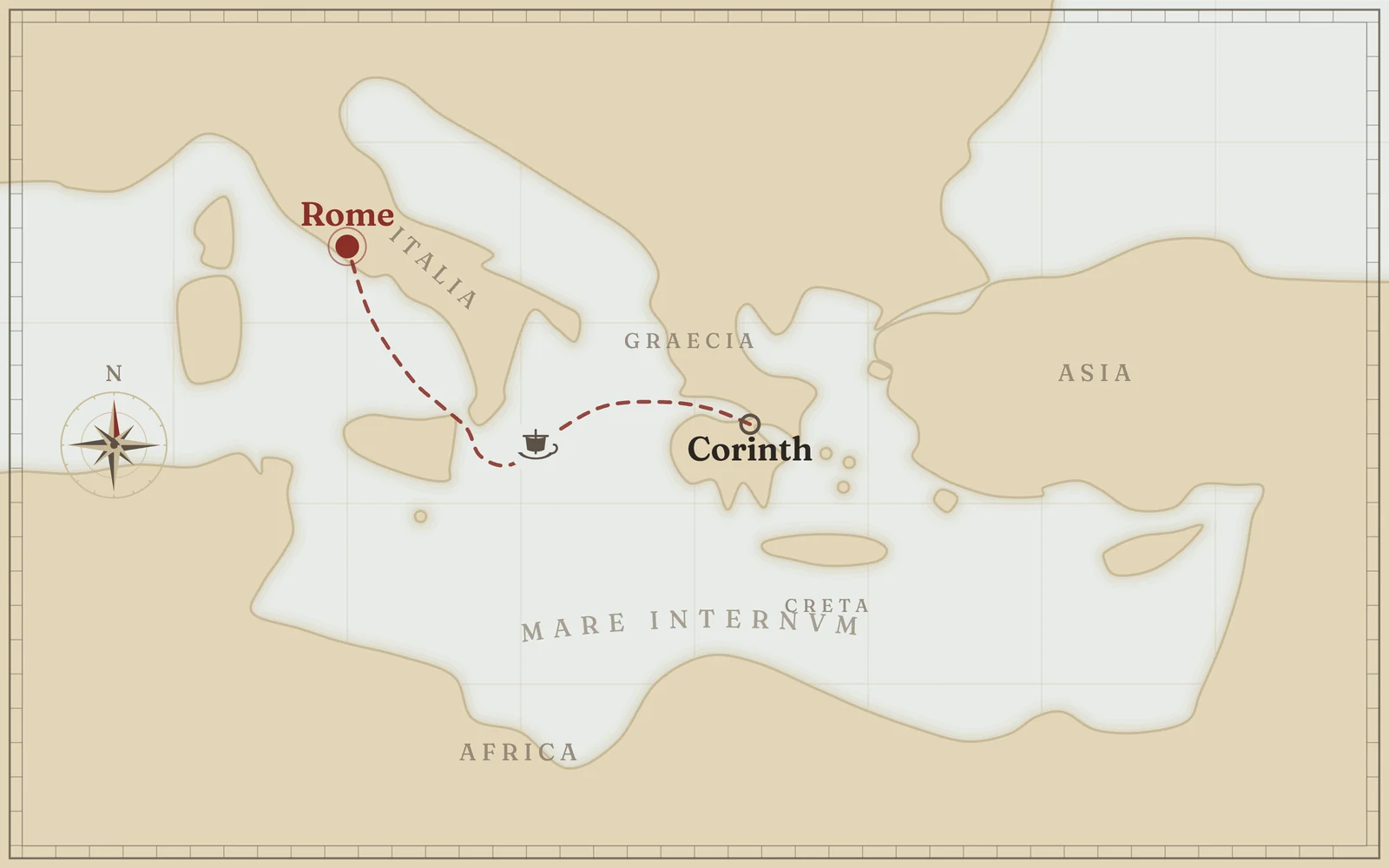
I wrote this letter around the middle of the first century, near the close of my third journey, from the city of Corinth — a stay of some three months in Greece before I turned toward Jerusalem. I was not in prison then, as I am now in Rome; I was a free man, but a burdened one, carrying a gift of money from the Gentile churches of Greece and Asia to the poor believers in Jerusalem, and uncertain of my welcome there. A woman named Phoebe, a servant of the church at Cenchreae, carried the letter for me (Romans 16:1–2). I dictated it to Tertius, who added his own greeting (Romans 16:22).
Its first readers were the Christians in Rome, whom I had not yet met. The congregation there was mixed — Jews who knew the Scriptures from childhood and Gentiles who had come in from paganism — and there was friction between them over the law, over food, over holy days, over who truly belonged. Some years before, Jews had been expelled from the city and had since returned to find the Gentile believers settled in. So I write to a people who need to see that they stand on level ground: all have sinned, and all are justified by the same grace through the same faith.
The letter moves in a clear order. First I show the whole world guilty before God — the Gentile in his idolatry, the Jew in his law-breaking — that every mouth may be stopped (Romans 1–3). Then I set forth how God puts sinners right with himself: freely, by grace, through faith in Christ, as Abraham himself was counted righteous by believing (Romans 3–4). From this justification flow its fruits — peace with God, and the reign of grace over sin and death (Romans 5). Then I take up the life that follows: dead to sin, alive to God, set free from the law's condemnation, and led by the Spirit through struggle into glory, held fast by a love that will not let go (Romans 6–8).
After that I wrestle with the hardest grief of my heart — my own people Israel, and how the promise of God stands firm even in their unbelief, and how in the end his mercy is wide (Romans 9–11). And having laid the whole foundation, I turn at last to how such people are to live: as a living sacrifice, in love without hypocrisy, in patience under governing authorities, in forbearance between the strong and the weak, welcoming one another as Christ has welcomed us (Romans 12–15). I close with my travel plans and a long roll of names, for the gospel is never an idea only; it is a people. Read it in that shape, and you will not lose your way.
There's more here than a single reading can hold — the questions behind the questions, the threads that run letter to letter. That's what a study room with Paul is being made for.